
In late October and early November, new NBN Trust CEO, Gareth Thomas, represented our charity at the 32nd GBIF: The Global Biodiversity Information Facility Governing Board and the Living Data Conference in Bogotá and then in São Paulo at COP30 Brazil Business & Finance Week.
Here we have a summary and reflections from Gareth from these events.
GBIF and Living Data Conference
This was an insightful introduction to the global biodiversity data community and a reminder of how interconnected and ambitious this field has become.
What struck me most was the pace of change. The way we collect, link and interpret biodiversity data is evolving rapidly; from new global standards to the use of AI, genomics and event-based approaches that bring science, policy and technology closer together. There’s also real energy around bridging marine and terrestrial systems, ensuring that our understanding of nature reflects entire ecosystems, not administrative boundaries.
COP30 Brazil Business & Finance Week
This was the first time the NBN Trust had featured in the global finance and biodiversity conversation on that scale. Our goal was to plant a flag for credible biodiversity data as infrastructure, and to show that this infrastructure must link with finance, policy, and corporate strategy.
Our message landed clearly: if we want credible investment in nature, we must also invest in the evidence engine that underpins it. That framing, data to insight to impact, resonated across every event.
For the NBN Trust, this is about making UK biodiversity data visible in global markets – showing that open, science-led infrastructure can underpin real investment decisions.
At COP30, the conversation wasn’t about whether nature matters; it was about how we measure, value, and invest in it. The NBN Trust represents the UK’s national biodiversity data system – we’re the bridge between biological recorders on the ground and the policymakers and investors shaping global responses. We exist to make data discoverable, usable, and trusted across government, finance, and civil society. We were at COP30 Business and Finance Week to represent every person who’s ever submitted a record; ensuring their efforts shape the policies and markets now being built around nature.
Alongside the Natural History Museum, we co-hosted a roundtable on Nature Data as Infrastructure and spoke at sessions with Bloomberg, United Nations PRI, and other partners exploring how credible data and models can turn ambition into allocation.
Risk doesn’t wait for the reporting cycle.
That line echoed through the week. At PRI in Person, the world’s largest responsible-investment gathering (and now almost indistinguishable from a climate conference). One concept was if we can’t measure nature, we can’t price it…and if we can’t price it, we can’t protect it. That’s both thrilling and risky. Thrilling, because it shows markets are finally catching up to ecological reality. Risky, because we’ve seen what happens when finance runs faster than governance.
At Bloomberg’s “Shape of Materiality” presentation, the same idea surfaced. In other words, waiting for perfect disclosure frameworks won’t cut it. Investors need live signals and data that moves as the world moves. The Taskforce on Nature-related Financial Disclosures (TNFD) announced it now has over 733 organisations across 56 countries committing to TNFD-aligned disclosures, including asset managers overseeing US$22.4 trillion in assets under management. Moreover, the International Sustainability Standards Board (ISSB) committed to drawing down on the TNFD and creating a biodiversity standard. That signals that nature-related data, reporting, and transition-planning are moving into mainstream financial disclosure practice.
Brazil managed to anchor all of this in reality. President Lula’s words captured the week: “Forests are not just lungs; they are the planet’s balance sheet.” The new Tropical Forests Forever Facility, with $5.5 billion already pledged, underscored that capital follows credibility.
Nature Data as Infrastructure
The roundtable “Nature Data as Infrastructure”, co-hosted by the NBN Trust and the Natural History Museum during the Climate Action Innovation Zone’s Sustainable Innovation Forum, drew great interest…proof of how fast biodiversity data is climbing up the finance agenda. The discussion asked one deceptively simple question: how do we treat biodiversity data as infrastructure for the economy?
Four themes anchored the dialogue:
- what data decision-makers actually need;
- how to bridge global frameworks with national systems;
- how to finance and sustain public-good data infrastructure;
- and how to move beyond pilots into scaled implementation.
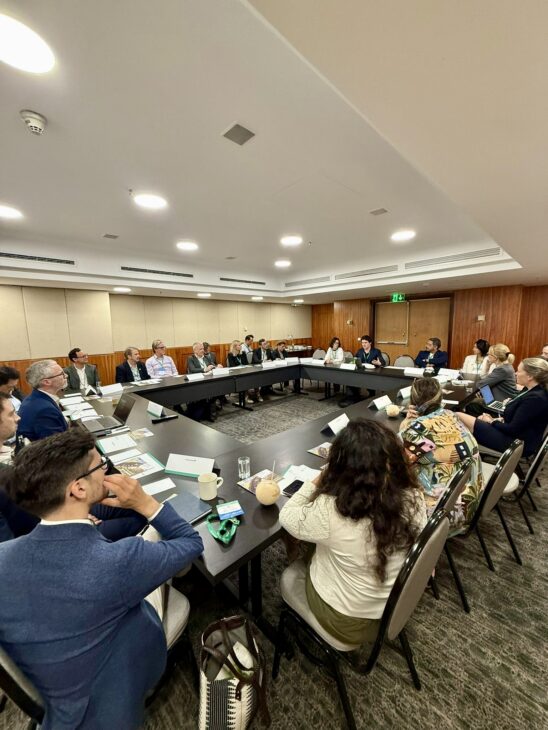
Some examples of interventions included: Mahima Sukhdev (GIST Impact) challenged the idea of a single metric, arguing that decision-grade biodiversity data must balance scientific complexity with usability. Kyle Copas (GBIF: The Global Biodiversity Information Facility) urged the room to see national data systems as the building blocks of the global network, public goods that need hybrid public-private finance. Lisa Eichler (MSCI Inc.) reflected on investor needs, noting that materiality still leans toward risk rather than opportunity, and that collaboration among data providers is key to credible market signals. Tomas Gomez (Environment Bank) grounded the conversation in implementation, stressing that scaling nature markets depends on verifiable, open data standards and trusted governance.
Three things I left thinking about:
- Data is the new due diligence. Disclosure alone isn’t enough. Investors want verifiable, spatially-grounded evidence. The challenge is interoperability and getting global comparability without losing local truth.
- Nature markets are real, but fragile. There’s enthusiasm for biodiversity credits, restoration bonds, and nature-linked instruments, but little consensus on baselines or permanence.
- The language is changing. The finance world no longer speaks about nature as philanthropy. It talks about exposure, risk, resilience, productivity.
As someone who has spent years in the space between science and markets, this week felt like a hinge-moment. Biodiversity data is becoming the connective tissue of how economies will measure progress. That’s both an opportunity and a warning: get the architecture right, or we’ll build a new system on the same old blind spots!
The Brazilian backdrop was fitting. You can’t stand there and ignore the truth that natural capital is not an abstraction. The question now isn’t whether nature belongs on the balance sheet, it’s whether we’ll make the numbers mean something real.
Reflections taken from Gareth’s EcoBiz newsletter – COP30 Business and Finance Edition.