
A new review of research from the Biological Records Centre (BRC) highlights the vital role of biological recording and national monitoring schemes and taxonomic societies in helping scientists understand how Britain’s wildlife is changing. The review is also being released alongside a new GBIF hosted portal that will help users explore the data collected by biological recording, which BRC helps to mobilise.
Drawing on over 140 million species records collected by volunteer recorders, recording schemes and citizen scientists, the review showcases how biodiversity data have transformed our understanding of the natural world over the past decade. From tracking shifts in species distributions to informing national biodiversity indicators, the research demonstrates the growing importance of citizen science for long-term monitoring in addressing environmental challenges.
Building a picture of change
The evidence reveals a complex picture of biodiversity change. While many species have experienced declines, others have expanded their ranges or benefited from environmental improvements. The records provide detailed insights into the impacts of climate change and pressures from land use.
Biological records are also helping researchers identify emerging threats. Data collected by volunteers have supported studies of invasive species, disease risks and range-expanding insect pests, providing early warnings that can help guide management and policy responses.
Exploring the available data – new portal complements the NBN Atlas
Data from national recording schemes is already shared by the BRC with the NBN Atlas, the UK’s largest publicly available source of biodiversity data. The NBN Atlas holds more than 387 million species occurrence records, and these data are also shared with GBIF where permissions allow.
The new portal provides a dedicated gateway to BRC data available through GBIF, making it easier to discover, explore and understand these datasets. It is expected to be particularly valuable for university researchers and international partners who use GBIF to access large-scale occurrence datasets across European or global scales.
The portal is likely to have two main uses:
- Introducing BRC and UK recording schemes, with links to relevant websites, additional
sources of information, and an overview of the wealth of biodiversity data available through GBIF. - Acting as a convenient reference point for dataset information, providing links, a catalogue of
BRC datasets available through GBIF, and tools to browse new or updated datasets and track usage
and citations.
The portal will also help showcase datasets through maps, visualisations and image collections, while providing opportunities to connect users with complementary data products that are not currently available through the NBN Atlas, such as spatial maps, trends and other outputs from structured citizen science schemes, including Butterfly Monitoring.
By bringing these resources together in one place, the portal will offer a BRC-focused view of datasets available through GBIF and help increase the visibility, accessibility and impact of data contributed by recording schemes and iRecord. Data sharing with the NBN Atlas will continue unchanged, ensuring these records remain available through established routes while benefiting from additional exposure through the new portal.
Supporting conservation decisions
The review demonstrates the value of biological recording for conservation planning and environmental decision-making. Species records have underpinned Red List assessments, informed the designation of important sites for nature, and contributed to national indicators used to measure progress towards biodiversity and nature recovery targets.
Citizen science at unprecedented scale
A recurring theme throughout the review, and shown by the data in the portal, is the growing contribution of citizen science. Digital recording tools such as iRecord have enabled more people than ever before to contribute wildlife observations, leading to significant growth in the volume and both taxonomic and geographic coverage of records.
Informing conservation and nature recovery
The publication also highlights the importance of long-term datasets. In some cases, records stretching back decades are allowing scientists to track environmental change over extended periods, revealing trends that would otherwise remain hidden. These records provide a detailed picture of changes in Britain’s landscapes, woodlands and wildlife, creating an invaluable resource for future research, policy development and conservation action.
Looking to the future
Looking ahead, the review points to new opportunities created by advances in technology, including artificial intelligence, automated monitoring and environmental DNA (eDNA). Combined with the continued commitment of volunteer recorders, these innovations are expected to further strengthen the UK’s ability to monitor biodiversity and respond to environmental change.
Overall, the review demonstrates that biological recording is far more than a record of where species occur. It provides the evidence needed to understand how nature is changing, evaluate the effectiveness of conservation action, and support efforts to restore biodiversity in a rapidly changing world.
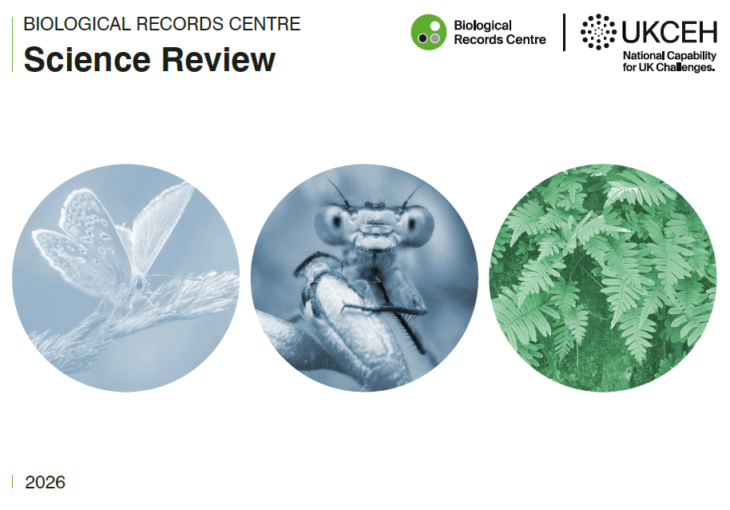
Read the Biological Records Centre Review
Key stats
The BRC has spent more than 60 years supporting biological recording, working with 110 recording schemes and societies. Today, millions of observations collected by volunteers underpin research, conservation and policy across the UK.
Key numbers:
- Over 140 million occurrence records
- 25,500+ species recorded
- 96 atlases published
- 5,440 species trend estimates
- More than 2,000 scientific citations
The BRC is supported by the Joint Nature Conservation Committee (JNCC) and the UK Centre for Ecology & Hydrology (UKCEH), a not-for-profit research institute which receives support from Natural Environment Research Council (NERC) as part of the NC for UK Challenges programme delivering National Capability.
The work of the BRC is a major component of the National Biodiversity Network (NBN).