
Blog written by Dr Adrian Cooper of Felixstowe Citizen Science Group and Felixstowe’s Community Nature Reserve
This discussion is presented in three parts. First, I will provide a summary of the background to this work. Second, I will summarise the three research methods employed here. Finally, I will explain how interpretations of three river estuaries have become part of local motivations to support community-based climate activism in the Felixstowe area of Suffolk, UK.
BACKGROUND
The estuaries featured in this research are the Blyth, Alde-Ore and Orwell, located in Suffolk, UK. Previous discussion has focused on the Deben and Stour estuaries.
Research for this discussion was conducted by the Felixstowe Citizen Science Group (FCSG). They are a voluntary organisation, established in April 2018. They have 37 members at the time of writing. Recent examples of their work may be found on their Facebook page. Additional recent work by FCSG on therapeutic walking and collaborative map making can be accessed here. Examples of recently completed collaborative maps can be viewed on the website’s Photo Gallery.
For this discussion, the Blyth, Alde-Ore and Orwell are recognized as complex environments (Schlesinger and Bernhardt, 2013). That includes the recognition that environments may be interpreted from many perspectives (eg scientific, aesthetic, educational / community resources, therapeutic and – for people of faith – local pilgrimage destinations (Cooper, 2000).
To analyse environmental complexity, this discussion will employ themes from Systems Thinking (Ramage and Shipp, 2009; and Reynolds and Holwell, 2010). It is therefore within that body of ideas where the Blyth, Alde-Ore and Orwell estuaries are recognised as being open to interpretations from a multiplicity of perspectives. That multiplicity is enhanced significantly where contributions to this research are received from an inclusive approach to interviewees where interpretations of these estuaries are included from women, young people aged 18 – 25, members of LBGTQ+ communities, people of faith and people of colour. At a time when the Felixstowe population is becoming increasingly cosmopolitan, that attention to inclusiveness by FCSG is justified.
An additional feature of the Blyth, Alde-Ore and Orwell estuaries which is recognized here concerns their liminal qualities (Downy, Kinane and Parker, 2016). That is, those estuaries are regarded as thresholds between land, river and sea; fresh water and salt water; terrestrial and marine ecology; inland and coastal systems; human territories and shared (multi species) water; vegetated and unvegetated areas; and low tide and high-tide. Liminality also includes reference to the transience of these estuaries ie between tidal and salinity fluctuations; shoreline movement; channel migration; sediment travel; changes in ecological populations; light and atmosphere changes (eg fog, mist, weather changes); and human activity.
The overall focus of this research is to show how the valuing of three Suffolk estuarine environments can support local participation in community-based climate activism. In this context, climate activism is defined as supporting Climate Justice, Climate Action Planning, and Methane Reduction. Discussion on how these approaches to community-based climate activism developed is presented here.
RESEARCH METHODS
This discussion used three research methods: walking, ethnography, and telephone questionnaires.
Walking around the river estuary environments with small groups of citizen scientists, along with invited guests, allowed local knowledge to be discussed and developed. Walking also allowed for ground truthing to be examined (Solnit, 2000; and Macfarlane 2022). In this way, walking became the basis for place-based questions which were examined during the ethnography and telephone questionnaires.
Ethnographic interviews in this research included small group meetings which were either structured, unstructured or semi structured (Hammersley and Atkinson, 2019; Delamont and Atkinson, 2021; and Madison, 2019). Interview groups for this research were never composed of more than seven interviewees. The benefit of these interviews was to provide this research with a depth of understanding.
Breadth of understanding was provided through telephone questionnaires (Edwards and Holland, 2023). In this research, FCSG used stratified random samples of one hundred members from Felixstowe’s Community Nature Reserve. Interview scripts had been developed through discussion among members of the Felixstowe Citizen Science Group (FCSG). The one hundred telephone calls were allocated within a data collection team of 25 FCSG members. In this way, each member of the FCSG data collection team only had four phone calls to make. Results were collated on a limited access Excel spreadsheet on OneDrive.
Although these three methods allowed for the inclusion of local knowledge (through the walking groups), a depth of discussion (through ethnography) and a breadth of data collection (through the telephone questionnaires), there remained significant challenges to this work through the multiplicity of data types (eg from estuarine environmental sights, sounds, fragrances, touch experiences, therapeutic experiences and – for people of faith – pilgrimage experiences). Equally, there are always challenges with data quality in any form of citizen science. To address those challenges, FCSG includes training, discussion and reflection in each of its monthly meetings. That training draws from Bennett and Humphries (1965), Fowler, Cohen and Jarvis (1998), and Magurran and McGill (2011). FCSG’s identity as a learning organisation in this context was discussed by Cooper (2019). Further discussion of FCSG’s data management has been discussed by Cooper (2024).
MOTIVATIONS TO SUPPORT COMMUNITY BASED CLIMATE ACTIVISM
For each of the three river estuaries considered in this discussion, a framework of five themes was investigated using the methods outlined above. These may be summarized as:
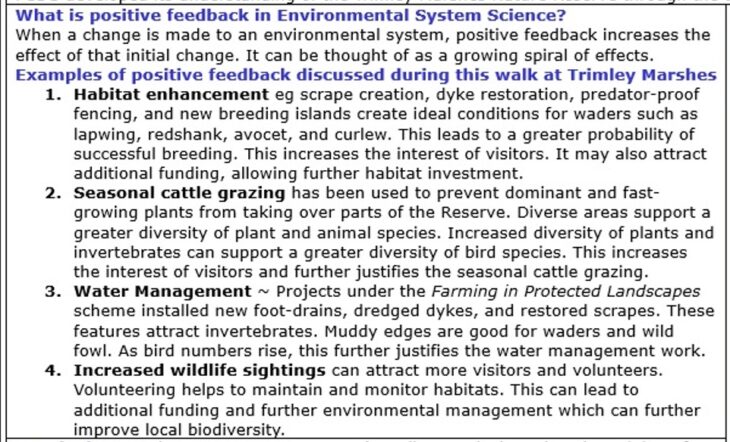
- Scientific – including the alignment of Physics, Chemistry and Biology in each estuary; Plant Successions; and foundational domains (ie symmetries in nature, electromagnetism, Carbon and Water). There was also a single case study of positive feedback within the estuarine system at Trimley Marshes Nature Reserve on 2 January 2026 as an exercise in helping the FCSG walkers to get used to the aims of this year’s work.
- Environmental Aesthetic encounters (Berleant, 1992)
- Educational / Community resource themes (Brady, 2003)
- Therapeutic experiences for mental and physical health (Cooper Marcus and Sachs, 2013; Foley, Kearns, Kistermann and Wheeler, 2019).
- Experiences of the estuaries as local pilgrimage destinations for people of faith (Cooper, 2000)
These themes were first recognised in FCSG’s 2025 research as being the core to local people’s motivations to support community-based climate activism. As an exercise in continuity, these same themes were investigated again during 2026.
The following extracts are taken from published reports which were shared, on the dates indicated, on the FCSG Facebook page.
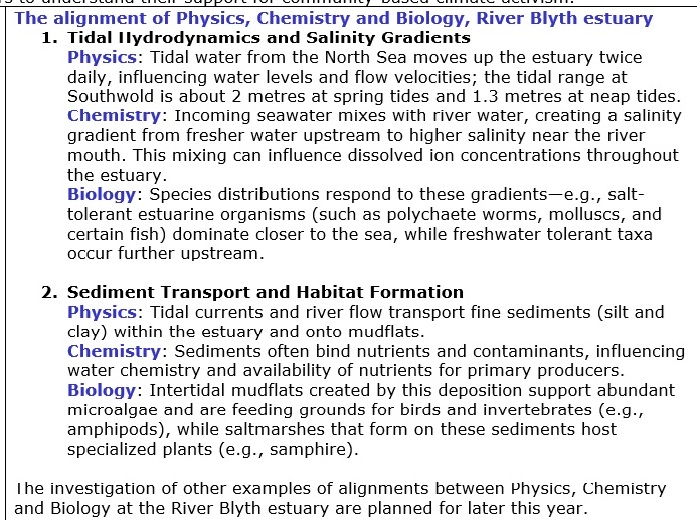
PHYSICS, CHEMISTRY AND BIOLOGY
River Blyth estuary, 2 February 2026. The walking group which developed the following conversations consisted of 21 members of FCSG and 10 invited guests from Felixstowe’s Community Nature Reserve.
________________________________________________________________________________________
River Orwell estuary at the Trimley Marshes Nature Reserve, 8 May 2026. The walking group which developed the following conversations consisted of 17 members of FCSG and 11 invited guests from Felixstowe’s Community Nature Reserve.
Alde Ore estuary, 24 July 2026. The walking group which developed the following conversations consisted of 22 members of FCSG and 9 invited guests from Felixstowe’s Community Nature Reserve.
PLANT SUCCESSIONS
Alde – Ore estuary, 15 February 2026. The walking group which developed the following conversations consisted of 12 members of FCSG and 8 invited guests from Felixstowe’s Community Nature Reserve.
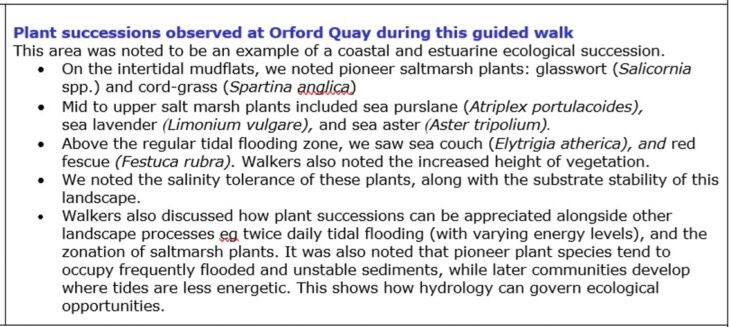
River Blyth estuary, 8 June 2026. The walking group which developed the following conversations consisted of 17 members of FCSG and 8 invited guests from Felixstowe’s Community Nature Reserve.
River Orwell estuary at the Trimley Marshes Nature Reserve, 16 August 2026. The walking group which developed the following conversations consisted of 25 members of FCSG and 15 invited guests from Felixstowe’s Community Nature Reserve.
FOUNDATIONAL DOMAINS IN SCIENCE
Symmetries were explored at the River Blyth estuary, 8 April 2026. The walking group which developed the following conversations consisted of 15 members of FCSG and 10 invited guests from Felixstowe’s Community Nature Reserve.
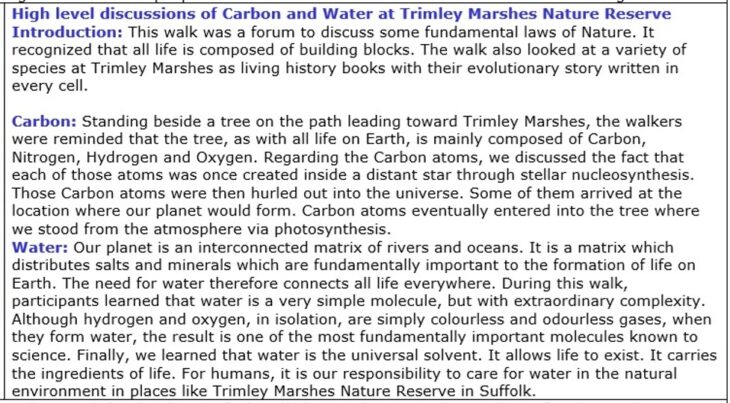
Carbon and Water were explored at the River Orwell estuary at Trimley Marshes Nature Reserve, 16 May 2026. The walking group which developed the following conversations consisted of 23 members of FCSG and 10 invited guests from Felixstowe’s Community Nature Reserve.
Electromagnetism was explored at the Alde – Ore estuary, 16 July 2026. The walking group which developed the following conversations consisted of 19 members of FCSG and 12 invited guests from Felixstowe’s Community Nature Reserve.
THE SINGLE CASE STUDY OF POSITIVE FEEDBACK AT THE TRIMLEY MARSHES ENVIRONMENTAL SYSTEM, 2 JANUARY 2026.
The walking group which developed the following conversations consisted of 17 members of FCSG and 10 invited guests from Felixstowe’s Community Nature Reserve.
ENVIRONMENTAL AESTHETICS AT THE THREE RIVER ESTUARIES
Alde – Ore estuary, 2 March 2026. The walking group which developed the following conversations consisted of 15 members of FCSG and 12 invited guests from Felixstowe’s Community Nature Reserve.
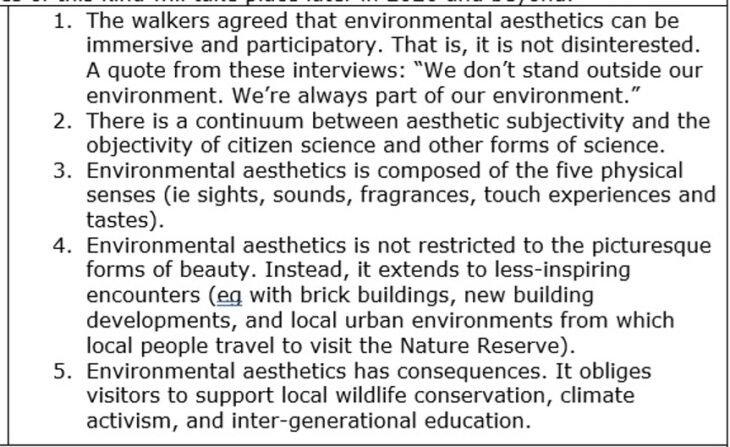
River Blyth estuary, 16 April 2026. The walking group which developed the following conversations consisted of 17 members of FCSG and 11 invited guests from Felixstowe’s Community Nature Reserve.
River Orwell estuary at the Trimley Marshes Nature Reserve, 8 July 2026. The walking group which developed the following conversations consisted of 21 members of FCSG and 10 invited guests from Felixstowe’s Community Nature Reserve.
THE ESTUARIES AS EDUCATIONAL / COMMUNITY RESOURCES
Alde Ore estuary, 16 March 2026. The walking group which developed the following conversations consisted of 19 members of FCSG and 10 invited guests from Felixstowe’s Community Nature Reserve.
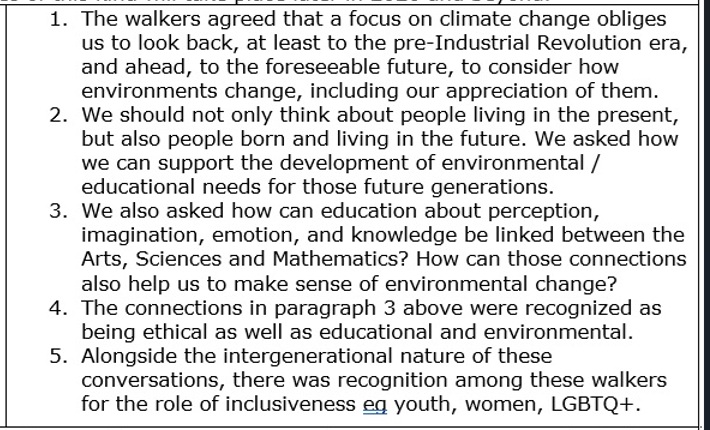
River Blyth estuary, 16 June 2026. The walking group which developed the following conversations consisted of 21 members of FCSG and 12 invited guests from Felixstowe’s Community Nature Reserve.
River Orwell estuary at the Trimley Marshes Nature Reserve, 24 August 2026. The walking group which developed the following conversations consisted of 21 members of FCSG and 10 invited guests from Felixstowe’s Community Nature Reserve.
THE ESTUARIES AS THERAPEUTIC ENVIRONMENTS
Alde Ore, 5 January 2026, at Hazlewood Marshes. This data was collected from 50 randomly chosen members of Felixstowe’s Community Nature Reserve through a telephone questionnaire.
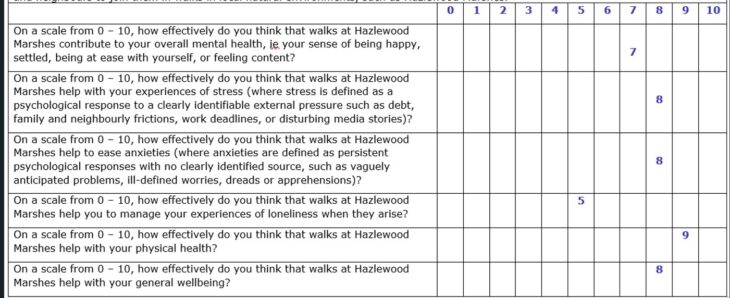
River Orwell estuary at Trimley Marshes Nature Reserve, 24 May 2026. This data was collected from 100 randomly chosen members of Felixstowe’s Community Nature Reserve through a telephone questionnaire.
River Blyth estuary, 10 September 2026. The walking group which developed the following conversations consisted of 18 members of FCSG and 12 invited guests from Felixstowe’s Community Nature Reserve.
THE ESTUARIES VALUED AS LOCAL PILGRIMAGE DESTINATIONS BY PEOPLE OF FAITH
River Blyth estuary, 24 April 2026. The walking group which developed the following conversations consisted of 8 members of FCSG and 17 invited guests from Felixstowe’s Community Nature Reserve.
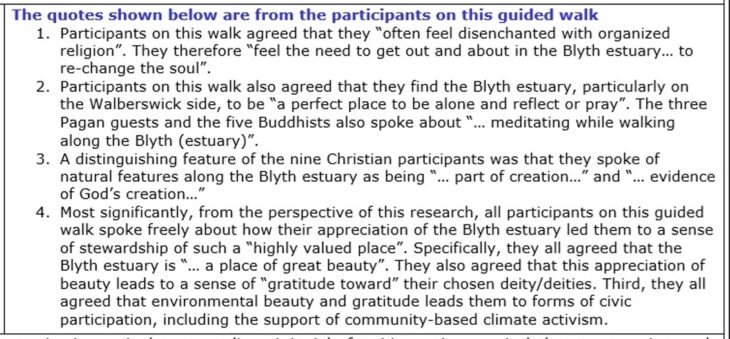
Alde Ore estuary, 24 June 2026. The walking group which developed the following conversations consisted of 8 members of FCSG and 19 invited guests from Felixstowe’s Community Nature Reserve.
River Orwell estuary at the Trimley Marshes Nature Reserve, 20 September 2026. The walking group which developed the following conversations consisted of 8 members of FCSG and 15 invited guests from Felixstowe’s Community Nature Reserve.
CONCLUSIONS
- This discussion has shown that guided walking groups can help members of the public to value local natural environments more intensely.
- It has also been shown here that valuing environments can be investigated by focusing on a five-part analytical framework of scientific, aesthetic, educational, therapeutic and spiritual / religious criteria. It was also shown here that scientific appreciations of natural environments in this context can be further investigated through themes which include the alignment between Physics, Chemistry and Biology in specific locations, Plant Successions, Foundational Domains, and Positive Feedback within Earth Systems Science. Although this framework helped FCSG as a research group, it also helped the participating walkers as they reflected upon the reasons why they choose to support community-based climate activism.
- The mixed methods approach adopted here has been shown to provide a credible contribution to understanding how local people develop their support for community-based climate activism. Indeed, there was a cyclical flow of qualitative and quantitative data which became recognised during the guided walking groups, and which subsequently fed into the ethnographic interviews and which later informed the telephone questionnaires. Interestingly, that flow of data collection fed back into further walking group activities later in the year.
- Although the mixed methods approach has been helpful, it introduced significant challenges of investigating diverse data types. Those challenges were addressed through FCSG’s Data Management. However, it is acknowledged that those challenges remain the cause of reflective practice within FCSG monthly meetings. The main challenge for FCSG is to separate its investigation of climate activism alongside its advocacy for that activism. That challenge is addressed through group reflection and discussion of the data collection and analysis cycle.
- At a time when the population of the Felixstowe area is becoming increasingly cosmopolitan, FCSG took the decision to embrace inclusiveness within its work. That decision led to additional diversity of data here.
- Participation in this research gave walkers a sense of empowerment and confidence within their support for community-based climate activism. That is, before they took part in this investigation, participants here described themselves as “feeling like a lone voice…”, “feeling isolated…”, and “often being laughed at…”. Having taken part in this research with FCSG, those same participants now describe themselves as feeling “listened to…”, “part of a network… ”, “confident…” and “a part of something that means something…”. In this way, FCSG’s work can be seen to contribute in a practical way to its local community.
- Further questions which arise from this discussion may be defined in five ways:
(i) In 2027, FCSG will continue to investigate local motivations to support climate activism. However, it will do so, during that year, by collecting data from groups who have witnessed mountain glacial retreat in Western Europe. In that way, new environmental contexts will be introduced to FCSG’s work which contrast significantly to its previous attention to local woodland and river estuaries. Although there will be a clear contrast in geographical attention, the theme of liminality (previously discussed with river estuaries) can be recognized in glacial environments too.
(ii) The mixed methods approach of aligning the experiences of walking groups, ethnographic interviews and telephone questionnaires will remain within FCSG’s agenda.
(iii) Inclusiveness of women, young people aged 18 – 25, members of LGBTQ+ communities, people of colour and people of faith will be continued. The benefit of doing so will enrich FCSG’s data sets. The challenges remain those which have already been recognised above.
(iv) Collaborative map making will also be encouraged as a way for participants to express their responses to nominated environments.
(v) Technologies drawn from AI and Geographical Information Systems will be employed to represent and communicate FCSG’s research.
REFERENCES
Bennett DP, and Humphries DA (1965) Introduction to Field Biology (Edward Arnold)
Berleant A (1992) The Aesthetics of Environment (Temple University Press)
Brady E (2003) Aesthetics of the Natural Environment (Edinburgh University Press)
Cooper AR (2000) Places of Pilgrimage and Healing (Capall Bann Publishing)
Cooper AR (2019) Felixstowe’s Citizen Science Group becomes a learning organization (online) https://nbn.org.uk/blogs/nbn-blog/felixstowes-citizen-science-group-becomes-a-learning-organisation/
Cooper AR (2024) A citizen science of data management, inclusiveness and influence on public policy (online) https://nbn.org.uk/blogs/nbn-blog/a-citizen-science-of-data-management-inclusiveness-and-influence-on-public-policy/
Cooper Marcus C, and Sachs NA (2013) Therapeutic Landscapes: An Evidence-Based Approach to Designing Healing Gardens and Restorative Outdoor Space (Wiley)
Delamont S and Atkinson P (2021) Ethnographic Engagements (Routledge)
Downey D, Kinane I, and Parker E, eds (2016) Landscapes of Liminality: Between Space and Place (Bloomsbury Academic / Rowman & Littlefield
Edwards R, and Holland J (2023) Qualitative Interviewing: Research Methods (Bloomsbury)
Felixstowe Citizen Science Group (2025a) Climate Action Plan (online) https://drive.google.com/file/d/1aB1kHNnRGWrX2l3UzGruKTozyZIib3SZ/view?usp=sharing (Accessed 5 September)
Felixstowe’s Citizen Science Group (2025b) Methane Reduction Strategy (online) https://drive.google.com/file/d/1izelgH2Yl5KGlwaAfpX4uKrQxhW4XlN6/view?usp=sharing (Accessed 5 September 2026)
Felixstowe Community Nature Reserve (2022) Climate Justice Agenda (online) https://drive.google.com/file/d/1F5KDB_ETTnx6oiXD20RRTGoGnn4dBJt1/view?usp=sharing (Accessed 5 September 2026)
Foley R, Kearne R, Kistermann T and Wheeler B, eds (2019) Blue Space, Health and Wellbeing: Hydrophilia Unbounded
Fowler J, Cohen L, and Jarvis P (1998) Practical Statistics for Field Biology (John Wiley)
Hammersley M, and Atkinson P (2019) Ethnography: Principles in Practice (Routledge)
Macfarlane R (2012) The Old Ways: A Journey on foot (Hamish Hamilton)
Madison DS (2019) Critical Ethnography (Sage)
Magurran AE, and McGill BJ (2011) Biological Diversity: Frontiers in Measurement and Assessment (Oxford University Press)
Ramage M, and Shipp K , eds (2009) Systems Thinkers (Springer)
Reynolds M, and Holwell S, eds (2010) Systems Approaches to Managing Change: A Practical Guide (Springer)
Schlesinger WH, and Bernhardt ES (2013) Biogeochemistry: An Analysis of Global Change (Academic Press)
Solnit R (2000) Wanderlust: A History of walking (Viking)