
News and events
Alan Wood – NBN Award for Terrestrial Wildlife Recording
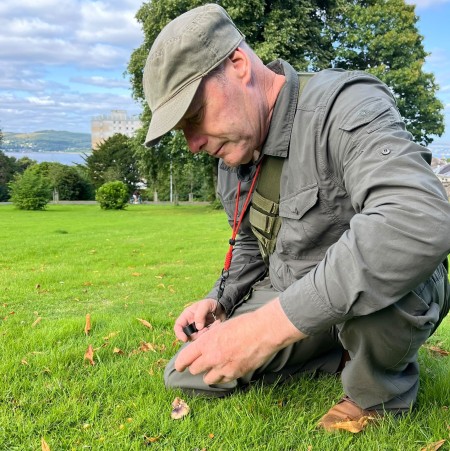
Alan Wood is from Greenock, Renfrewshire (Inverclyde)
What is it that excites, motivates and inspires Alan to record?
“I have been passionate about recording since getting interested in natural history while at school in 1970’s, initially with a keen interest in birds. I was heavily involved in the Scottish Ornithologists’ Club Clyde Branch and was jointly responsible for organising various surveys over the years such as breeding Sand Martins, Rookeries, Corvid roosts, tetrad breeding birds atlas project and post-breeding waders. I also organized the local WeBS and Heronries counts for many years and assisted in organising the various national projects arranged by the BTO.
I have always been driven to record with a purpose, wishing to understand populations and distributions, what might limit them and why they change. Having seen species fortunes change in my lifetime I feel I have contributed in part to the record of some of these changes. When I started out, I read vague descriptions of how common some species were that had declined or been lost locally and wished there had been a better record of these. I determined that I would do my bit to put my data on the record so future naturalists would have a more complete record to work with. There is nothing more satisfying than a map with dots on it and detailed records behind each dot!
My main focus these days is fungi. I took up an interest in this under-appreciated group in 2016 and it quickly ‘mushroomed’ into an obsession. I am a regular contributor to the FRDBI, and it appears the most active in Scotland. While most people would associate fungi with the autumn, they are with us all year round although most of the ‘toadstool’ type are found in the autumn. I developed an all-inclusive approach to fungi and love the challenge of finding then almost anywhere at any time of year (I have even recorded them while out at night carrying out bat surveys). I am an active member of my local Clyde and Argyll Fungus Group and lead a few of the forays for the group each year. I have also presented a couple of talks to the group where I have demonstrated my approach to finding fungi. I am fortunate to work as an ecologist at the former ROF Bishopton, one of the largest brownfield regeneration sites in Europe. It is there that I developed my interest in fungi and from an initial list of 62 species provided by the local BSBI recorder during and ‘out of season’ survey prior to the redevelopment, the total species recorded now exceeds 860 with several new to Scotland among them. My favourite among them is perhaps Pluteus aurantiorugosus, the Flame Shield, found growing at the rotten base of a Wych Elm in July 2016 and still fruiting in the exact same location eleven years later. This record of longevity is another important aspect of recording.
Working in ecology I know only too well how important it is that things are recorded if we wish to care for them.”